Velocity demands friction to become traction. We measure the space between the signal and the impact, knowing that truth unanchored to timing is indistinguishable from error. The market tests our discipline not by proving us wrong, but by making us wait.
A timing note: this issue grades the week ending Friday 10/30 and publishes late — the house cadence is the weekend after the close, 10/31–11/1 — alongside Issues #14, #15 and #16, which are on the site; this is the only one of the four sent by email. The autopsy result and the Eaton conversion test went to the public ledger on Tuesday 11/3: the test pre-registered at 5:28am ET, its result after Eaton's 10-Q was accepted at 12:07pm ET. The next issue grades the week ending Friday 11/6.
The Autopsy: Vindicated
The record, in the ratified order:
- The grade: thesis vindicated. On the release's one-decimal tables, Vertiv's Americas organic sales grew 66.2% against the 37.0% bar; current deferred revenue at September 30 was $4,120.5M against the $3,633.7M June balance, up $486.8M. Both were pre-registered on the public ledger on 10/24; no null branch triggered.
- The loss stands: −14.50, booked at the 10/16 cut; the realized record is unchanged at −8.19 across three closes.
- The calibration stays null: entry #003 was fixed at the breach.
- The cut has cost 12.85 points through Friday's close (The Record, below).
The sector desk's sentence, written on 10/24 before the print, prints as written:
"The survival cut fired on the noise of a capital-starved market, but the iron remains solid… demand is merely delayed by grid friction, not destroyed. The physical bottleneck thesis was structurally sound; we were simply shaken out by the mechanical gravity of the tape."
[Editor's note: The mechanism clause 'delayed by grid friction' reflects the desk's inference from sequential deferred-revenue deceleration; Vertiv's prepared remarks explicitly stated pacing items are 'not slowing down growth.']
On the record. Vertiv quantified orders once — the release headline read "Organic Orders Growth over 100%," and the prepared remarks said: "You know, we do not disclose orders and we'll continue not to, but it is worth sharing that our Q3 orders were more than 100% up year-on-year, organically." Earlier in the same remarks: "By the way, to be clear, we're not planning to share orders data going forward." The figure is total-company and directional. Organic Americas orders — the metric position #3's original falsifier was written on — were quantified in no venue.
The CFO said revenue delayed from Q2 "did filter into the Q3 number… we capped it somewhere around $100 million-$150 million." Remove the full $150M from Americas organic growth and it is still 57.5% (computed). The pull-in does not change the grade. But, the editor ruled, a beat partly made of shifted revenue is a weaker vindication than the raw figure suggests. The computed 57.5% is how much weaker.
The desk's inference. Deferred revenue still rose, but by the smallest sequential amount of 2026 (Q1 +$647.1M, Q2 +$1,171.9M, Q3 +$486.8M), and a gross-addition proxy — the balance change plus revenue recognized from it — fell from $1,776.7M to $1,105.9M (computed). That deceleration is the basis for "delayed by grid friction"; the company attributed it to nothing.
Guidance rose: full-year organic growth to 37–39% from 30–32%, after Q3 revenue of $4,312.8M against a $3.75B consensus (Investing.com). On Wednesday 10/28 Vertiv rose 16.48% (208.56 → 242.94), 12.76 points ahead of its eight-name group. The whole move was the opening gap.
The Tape
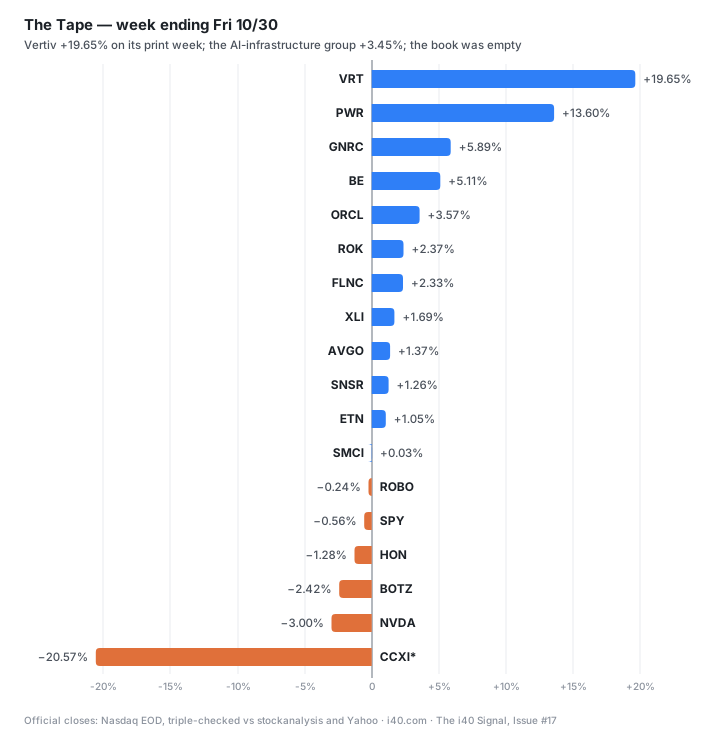
The AI-infrastructure group is equal-weight ETN, PWR, SMCI, NVDA, AVGO, ORCL, GNRC and BE. *CCXI is Agility's pre-close SPAC, tracked for the merger only; its −20.57% reads as post-redemption-deadline mechanics.
Vertiv +19.65% against XLI +1.69%, a residual of +17.96; the group +3.45%, Vertiv 16.19 points ahead of it; SPY −0.56%.
The Record
Missed #3: The October 28 thesis-signal autopsy resolved as Vindicated, requiring a same-day ledger annotation that was not made. The 10/24 pre-registration sat on the public ledger, so its resolution was rule-6 news; the annotation went up on 11/3, six days late. The Eaton trigger, which was not on the public ledger when it was met, and the Doña Ana County vote, which did not fire, are not "Missed."
The cost of the cut. Re-anchored at the 10/16 exit closes: avoided 3.99 at 10/23 → cost 12.85 at 10/30 (VRT +12.63% vs XLI −0.21% since exit), a −16.84 swing in one week, with the cost peaking at 17.72 on Thursday 10/29. A counterfactual, not a result.
To the hostile reader, the quant desk:
"You are right; we booked a −14.50pp loss, and the risk limit executed the cut. The limit did exactly what it was designed to do: cap a loss at a known maximum size at a pre-committed price. It cost us 12.85 points of post-exit upside by 10/30, after initially avoiding a 3.99-point loss at 10/23. A vindicated thesis does not convict the limit because truth and price operate on different clocks. We were fundamentally correct on the iron, but the limit enforced the mechanical reality of the tape."
The review-scope rule, ratified as house law: "A post-exit review of a risk limit may legitimately examine the mathematical alignment between the limit’s depth (−1200bps) and the instrument’s historical volatility profile over the intended thesis horizon. It must NEVER retroactively re-fit the limit to the realized price path or the post-exit counterfactual to manufacture a hypothetical survival."
Scoreboard (total-return, exit anchors). #1's foregone gain widened 3.61 points to +4.62 (BOTZ −2.42% against XLI +1.69%). #2's survival dividend grew 3.43 to +16.08 (Rockwell +2.37% against Honeywell −1.28%), ending the two-week run of Honeywell over Rockwell. #3: cost 12.85; the from-entry difference (held −4.34 against booked −14.50) is 10.16. The sign rule, ratified: For Ledger #3, a positive since-exit spread is the COST of the cut, and a negative spread is an AVOIDED loss; the term "foregone" remains strictly on Ledger #1's line. The from-entry difference mixes anchor classes and is an artifact, not the scoreboard figure. Forward flag: Honeywell goes ex $0.70 on Friday 11/13, its second dividend since the exit, adding 0.2843 points to its total return from the 246.21 exit anchor; from the grade of the week ending 11/13, that dividend lowers the survival dividend by 0.28 points.