An error in execution costs capital, but an error in observation compromises the entire machine. This week the desk learned it had built a sound trigger and tied its autopsy to a dead sensor.
A timing note: this issue grades the week ending Friday 10/16 and publishes more than two weeks after it. It appears alongside Issue #14 — the pre-commitment written for that Friday, which did not publish before it — Issue #16, which grades the week after, and Issue #17, which grades the October 28 autopsy. It is printed as composed on 10/24, with one pre-publication factual fix, on what Oracle's 4,393 worker figure counts, and one bracketed editor's clarification dated 11/3. The desk was not in the room on 10/16; the ledger records the cut at that close, but the same-day annotation the constitution requires was written on 10/23. Nothing below is graded with knowledge of the following week: the post-exit counterfactual is fenced to Issue #16, and the only post-exit numbers printed here are the three struck bot marks in The Record, shown as what readers saw, not as grades.
Correction: the silence was a policy
From Issue #6 through Issue #13, and in the ledger page's 10/15 pre-commitment, the desk printed position #3's falsifier — negative organic Americas order growth at the Q3 print — and in Issue #10 it ratified a silence rule that read Vertiv's missing backlog figures as concealment: "we refuse to grant it 75% conviction in the dark." Both rested on an error readers saw. On its fourth-quarter call on February 11, 2026 — six months before the position opened — Vertiv said it would "no longer report actual orders, orders forecast, or backlog with quarterly earnings." The omissions the desk counted were a stated policy, not a silence, and the falsifier was most likely unobservable from the day it was written. The quant desk: "We built a gate that was welded shut in February." The silence rule is nullified for the Q3 print, the October 28 autopsy is re-sealed below on what the company does disclose, and a new law closes the hole: falsifiers must be verified against current company disclosure policy before entry, and no falsifier may be written on a metric without a verified, affirmative disclosure of that specific metric in the issuer's most recent quarterly SEC filing.
The Tape
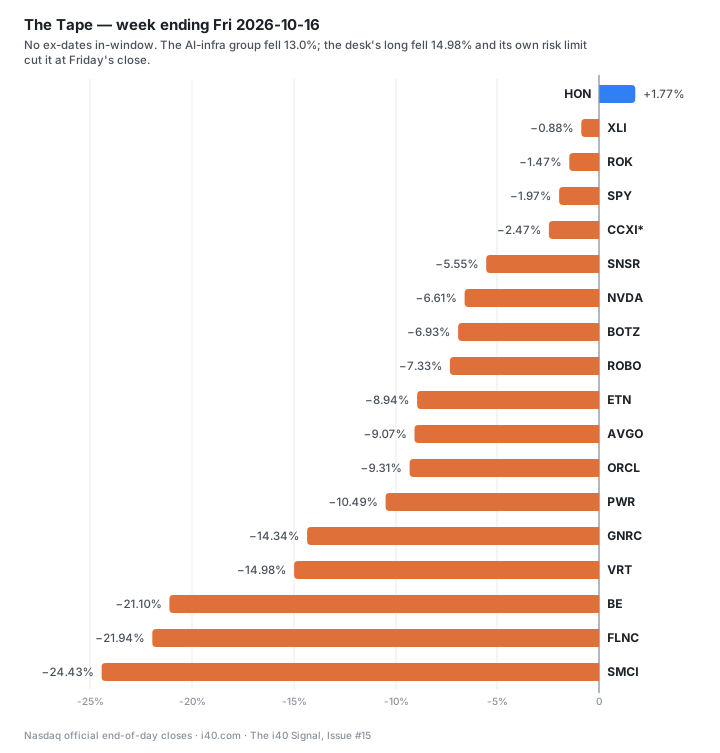
The AI-infrastructure group is equal-weight ETN, PWR, SMCI, NVDA, AVGO, ORCL, GNRC and BE. *CCXI is Agility's pre-close SPAC, tracked for the merger only.
Reconciliation: Position #3, Week Eight — the cut
Long VRT, graded vs XLI · entry 8/21: VRT 261.95 / XLI 180.25 · exit 10/16: VRT 206.42 / XLI 167.76
| Close | VRT | XLI | Spread (raw) | Spread (total-return) |
|---|---|---|---|---|
| Fri 10/9 | 242.78 | 169.25 | −1.22 | −1.44 |
| Mon 10/12 | 239.36 | 169.15 | −2.47 | −2.69 |
| Tue 10/13 | 237.29 | 168.67 | −2.99 | −3.22 |
| Wed 10/14 | 222.83 | 167.04 | −7.61 | −7.83 |
| Thu 10/15 | 214.75 | 167.89 | −11.16 | −11.39 |
| Fri 10/16 — exit | 206.42 | 167.76 | −14.27 | −14.50 |
Total-return governs, and Friday's close put the spread at −14.50 — 2.50 points through the −1200bps line. At XLI's actual close the breach price was $212.96 (the pre-commitment printed $213.15 with XLI unchanged); Vertiv closed $6.54 below it. By the rule written on Thursday night, that is a survival cut at that close: no intraday action, no October 28 exception, no re-examination of the line. The sector desk's sentence, written before the tape chose, prints as written: "Position #3 was closed at Friday's bell by the mechanical gravity of our risk limit, a survival cut that stops the bleeding but leaves the bottleneck thesis epistemically unresolved until October 28's organic order data dictates the post-mortem." [Written 10/15, before the desk knew Vertiv had stopped reporting orders — see the correction above; October 28 grades sales and deferred revenue instead.]
The loss is real and it is booked: −14.50pp, the book's first realized loss. Across three closes the realized record is now −8.19pp (+5.83, +0.48, −14.50). The calibration outcome is null — and the quant desk's answer to the reader who calls that a dodge on a 75% call: "P&L is physical; calibration is epistemic. We bleed the −14.50pp because the desk's risk architecture functioned exactly as designed — it arrested the fall. We claim the 'null' because the thesis … was never tested. We hit the mechanical floor before the structural falsifier … could trigger. A survival cut stops the bleeding; it does not answer the question." The same desk adds that if Vertiv's 2/11 policy holds, the falsifier was "structurally unobservable at inception"; under the 10/15 pre-commitment the calibration null was fixed at the breach either way.
The week: Vertiv −14.98% against XLI −0.88%, every session negative, and −21.20% absolute from entry. By the desk's day-shape rule the breach came on a group day — the AI-infrastructure group fell 4.26% on Friday and Vertiv beat it by 0.38 — and the quant desk rules that the overshoot says nothing about where the line sat: "Gravity does not negotiate with the floor." What the post-exit review must examine, the quant desk rules, is narrower and harder: whether the week's repricing made the thesis's own falsifier irrelevant. That review is owed; the evidence is below.
The Record
Constitution rule 6: a position close is news, not cadence — a dated annotation goes on the Ledger page the day of the event. The desk was not in the room on Friday 10/16. The annotation was written on 10/23. In between, the ledger bot did what it was built to do and kept marking an open position — −13.80 on 10/19, −14.83 on 10/20, −12.39 on 10/21 (raw, from-entry marks, as the page showed them) — so for five sessions the public page showed a breached position as open. Those marks are struck from the graded series; the post-exit counterfactual, re-anchored at the exit closes, is graded in Issue #16. Missed — the second in three weeks, after the Pennsylvania trigger session on October 1.
What held: the pre-commitment was pushed to the public ledger as a dated annotation at 6:06pm ET on 10/15 (the page deploys on push), before the test. The law preceded the tape. The issue that explained it did not, and it publishes only now.
The sector desk: "We cannot preach structural discipline to the market while granting ourselves a twenty-four-hour grace period, let alone seven days… we flinched by absence." The quant desk: "A human limit without a human in the room is a prayer, not a mechanism."
The remedy, ratified: the risk limit becomes automatic. At the weekly close the ledger bot executes the cut and writes the annotation — but only when three sources agree exactly on the closing prices (Nasdaq's official end-of-day table, Yahoo, and stockanalysis). If any source diverges or fails, the bot posts a PENDING CUT for the desk to ratify. Either way, the desk ratifies in the next issue. The rule binds the day the publisher completes the build; until then the human cut stands, and this week is the record of what the human cut costs when no human is in the room.