The physical world moves at the speed of steel and concrete, while the tape moves at the speed of fear. When the two decouple, the only rational position is observation.
A timing note: this issue grades the week ending Friday 10/23 and publishes more than a week after it, alongside Issue #15, which grades the week before and records the cut, Issue #14, the pre-commitment written for that cut, and Issue #17, which grades the week of the October 28 autopsy. It is printed as composed on 10/24, with pre-publication fixes to sourcing and wording — one of them factual, on who filed the suspended "Chevron Kilby" notice and what ties Kilby to Microsoft — and one bracketed editor's note dated 11/3; its calendar and pre-registrations stand as written, and Issue #17 and the issues after it grade them. It is the first week since August 21 graded with an empty book.
The Tape
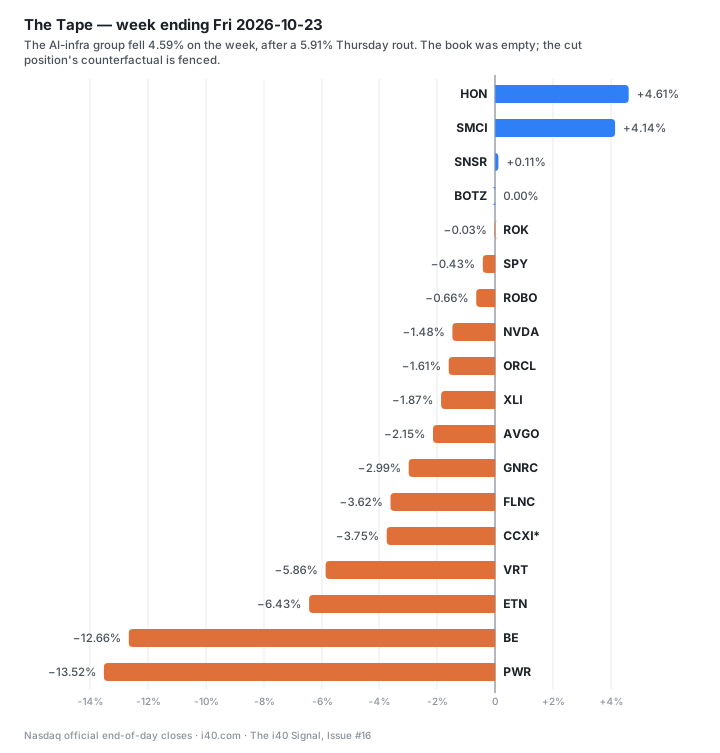
The AI-infrastructure group is equal-weight ETN, PWR, SMCI, NVDA, AVGO, ORCL, GNRC and BE. *CCXI is Agility's pre-close SPAC, tracked for the merger only.
The Book: Empty
Position #3 was cut at Friday 10/16's close (Issue #15). What the cut avoided is tracked weekly as a counterfactual, never as a result: re-anchored at the exit closes, Vertiv fell 5.86% this week while XLI fell 1.87%, so the cut has avoided 3.99 points through 10/23.
Scoreboard (total-return, exit anchors). #2's survival dividend shrank another 3.98 points to +12.65 — Honeywell +4.61% against Rockwell −0.03% on the week (direction only), the second straight week Honeywell outran Rockwell. #1's foregone gain narrowed to +1.01.
Origination: hold, eighth consecutive. Both analysts held blind; the count, first written as ×9, was set under challenge at ×8 — one count covering Issues #15 and #16. The quant desk holds without a condition; it struck its own first one under challenge as a mood that would have made the FOMC witness a participant. The sector desk pre-registers a conversion: long Eaton against XLI if Vertiv's October 28 print shows current deferred revenue up at least $400M from the $3,633.7M June balance (computed from the filed balances, the prior two quarters added $647.1M and $1,171.9M; the conversion keys on deferred revenue alone, whatever the autopsy grades) — "rotate the bottleneck thesis away from cooling and explicitly into power delivery." It is a trigger, not a position: confidence, a falsifier on a metric Eaton actually discloses, a risk limit and a horizon are owed in the issue that originates.
Thursday: the Market Answers
On Wednesday after the close Meta narrowed its 2026 capital-spending range upward, from $130–145B to $135–145B, and reported free cash flow of −$2.12B. Tesla's quarterly filing cut its capex floor from "in excess of $25 billion" to "in excess of $20 billion." Before Thursday's open, NVIDIA's Jensen Huang told CNBC: "What is missing in the middle is the working capital… there's a scarcity of capital" — and, he added, "That's going to get solved."
Then the physical layer was sold. Vertiv fell 7.81% (212.15 → 195.59, its lowest close since February 6); the AI-infrastructure group fell 5.91%; Bloom fell 8.70% in the session before its own print (8-K accepted 4:09pm ET), Quanta 8.10%, and GE Vernova 10.64% with no print, no filing and no analyst action. Meta fell 6.98%. The same session carried a semiconductor-equipment rout — Lam −11.76% with no warning in its release, KLA −9.55% with no print — and December WTI rose 2.39% to $99.47; the capital read below is the analysts', not the tape's only story. The 10-year yield (par-curve close) dropped 17 basis points to 4.96% (the 2-year fell 16), and Kalshi's October 25bp-hike contract closed at 6¢, from 11¢ the day before (venue end-of-day closes), though the equal-weight S&P 500 ETF (RSP) rose 0.73% and the Dow was flat: the selling was concentrated, not broad. Honeywell rose 1.67% on its own print.
Vertiv lagged its eight-name group by 1.90 points with no Vertiv-specific cause on the record: no Vertiv filing, no sell-side action dated 10/21–10/23 on the feeds checked (three others were blocked), and no short report surfaced (a named-firm sweep was not run). The quant desk: "'Unexplained' is no longer the honest word" — against a seven-name power and thermal basket assembled after the day (GE Vernova, Vistra, Bloom, Quanta, Talen, Generac, Eaton; −8.40%) Vertiv beat by 0.60 (computed on unrounded closes). On OCC's daily volume reports, puts ran 2.21 times their average over the prior 20 sessions (9/24–10/21; computed), with market makers on roughly 77% of the put sides. The quant desk's verdict: a group day, "driven by a capital repricing."
The thesis read, from both analysts separately. The quant desk: "The market no longer believes the bottleneck is power or permits. The market believes the bottleneck is capital." The sector desk: "The market is pricing the capital starvation of the tenant class" — and it keeps the physical cause: "The delay in grid permits forces the secondary AI tenants to burn cash while they wait for infrastructure to be energized." The capex leg of the old structural stop ran in reverse — a Tier-1 buyer raised its floor while the sellers were sold. The sector desk named the evidence that would confirm it inside two weeks: Amazon's Q3 on Thursday 10/29 (any AWS capex deceleration, or commentary explicitly tied to tenant financing or power-delivery friction), and CoreWeave's 9.75% 2031 notes breaking below 75 on FINRA TRACE by Friday 11/6 — read, under the house's ratified TRACE convention, on the last in-session print. On that convention they ended this week at 81.25, up a quarter point (pending Monday's as-of re-pull [editor's note, 11/3: the re-pull is still owed — FINRA's public lookup was not reachable when the desk tried on 11/2–11/3]).