Editor's note (Tuesday 11/17). Issue #18 was composed, verified, and committed as a draft on Sunday, November 8, and was not published until now. It prints here exactly as drafted to preserve the integrity of the record, with bracketed editor's notes beside every present-tense line that was falsified by the delay. Readers should note that the rules and pre-registrations contained herein were not public before the events they governed; they take effect for the house upon this publication. Issue #19, published alongside, carries the outcomes.
We measure the exact distance between regulatory friction and physical energization. The market trades on the assumption of infinite scale, yet reality enforces a strict calculus of constraints. Every delayed permit and severed interconnection agreement strips away the illusion of uninterrupted growth.
A timing note: this issue grades the week ending Friday 11/6 and publishes on cadence, Sunday night. [11/17: It did not publish on Sunday 11/8; it publishes now, with Issue #19.] Position #4's entry closes were locked and posted to the public ledger on Sunday 11/8. The next issue grades the week ending Friday 11/13.
Correction. Issue #16 stated Microsoft gave no reason for leaving Nscale's Loughton site. That was incorrect at publication. On Wednesday 10/21, inside that issue's graded week, Microsoft UK & Ireland Chief Executive Darren Hardman, asked on CNBC what happened with the project, said: "This particular project is related to [the] ability to get access to the electricity grid, access to the grid." Microsoft's written statement on 10/19 gave no reason; its executive provided one two days later. Our sweeps missed the interview. The tripwire ruling stands: by the letter then in force, Loughton did not fire.
The Entry
Position #4 entered at Friday 11/6's close: ETN 341.72 / XLI 162.67, on Nasdaq's official end-of-day table, stockanalysis and Yahoo. The anchor law set the date: the first Friday close strictly after publication, and Issue #17 published Wednesday 11/4 at about 01:00 ET. The book holds a position for the first time since 10/16.
#4 — Long ETN, graded vs XLI as the total-return residual. Thesis: "The physical bottleneck has migrated to power delivery, and Eaton's compounding Electrical Americas backlog—driven by combined data center and C&I demand—proves the market is mispricing the duration of the electrical infrastructure build-out." · Confidence 65% · Falsifier: Electrical Americas organic change in customer orders (trailing twelve months) below +25% in the Q4 2026 10-K; the Q3 10-Q shows +39% [11/17: As Issue #17 printed them, #4's terms also carry the omission clause: "An unexplained omission of that previously filed metric without a declared policy change is ruled concealment and closes the position automatically, scored on the calibration curve as a falsifier exit (a loss)".] · Risk limit: −1200bps vs XLI (total return, weekly close) · Horizon: through the Q4 2026 10-K · Structural stop: none.
Context: Before the position existed.
- Last close before publication (11/3) to entry (11/6): ETN −12.76% vs XLI −5.05%, residual −7.71.
- The week, 10/30 to 11/6: ETN −7.64% vs XLI −2.83%, residual −4.81.
- 11/3 to 11/5: ETN −16.51%, its worst two-session decline in five years of data.
- The entry close sits 25.71% below the 8/12 peak close.
Position #4 entered at the 11/6 close. ETN's −7.64% week and its −12.76% fall from the last pre-publication close occurred before the position was opened. They are volatility context, not a graded result. And the primaries cannot separate positioning unwind from any repricing of the build-out.
Why it fell depends on the frame. Eaton's Tuesday print was a beat and a raise (Eaton's Quarter, below); the fall came in the next two sessions. The facts: no primary carries an Eaton-specific catalyst (EDGAR: one Form 4, shares withheld for tax on vesting RSUs); seven carriers show no rating change; four price targets fell and two rose. On Wednesday 11/4 Eaton fell 9.86%, matching the seven-name power basket Issue #16 printed, ex-Eaton, to 0.02 points, while the eight-name group ex-Eaton fell 5.86% (Eaton −4.00 against it). On Thursday 11/5 it fell 7.38%: less than the US data-center power names (VRT −14.02%, PWR −12.30%), more than diversified multi-industrials (HON −5.55%, EMR −4.59%). Wednesday, on our reading, was a rotation from suppliers to buyers: MSFT +6.68% and AMZN +6.12% against VRT −12.89%, NVT −12.72% and PWR −11.65%, with SPY +1.65%.
The attributions, labeled. Eaton fell with other AI-infrastructure suppliers on 11/4 amid election-linked concerns about a data-center slowdown (CNBC Investing Club; TIKR); the Club's portfolio is long Eaton. AP said on 11/5 that the midterm results "raised the possibility that governments could force pauses in construction of more data centers." Meta's president, Dina Powell McCormick, at a WSJ conference on 11/4 (via relays): "to start new data center build-outs today in the United States will be very challenging."
Eaton's OCC put volume ran 1.42 and 2.00 times its 10/6–11/2 mean on 11/4 and 11/5, against 4.65 times for Vertiv and 4.63 times for Quanta on 11/5; its FINRA off-exchange short-sale ratio was 34.6% and 24.0%, the latter below all 20 baseline sessions. Our inference: the low ratios are consistent with holders selling across the group, though the ratio does not discriminate why. On 11/4 and 11/5 Eaton traded about 2.3 times and 2.5 times its pre-print 20-session average. House rule from this issue: every event-day volume multiple uses the 20 sessions before the event as its baseline.
The Tape
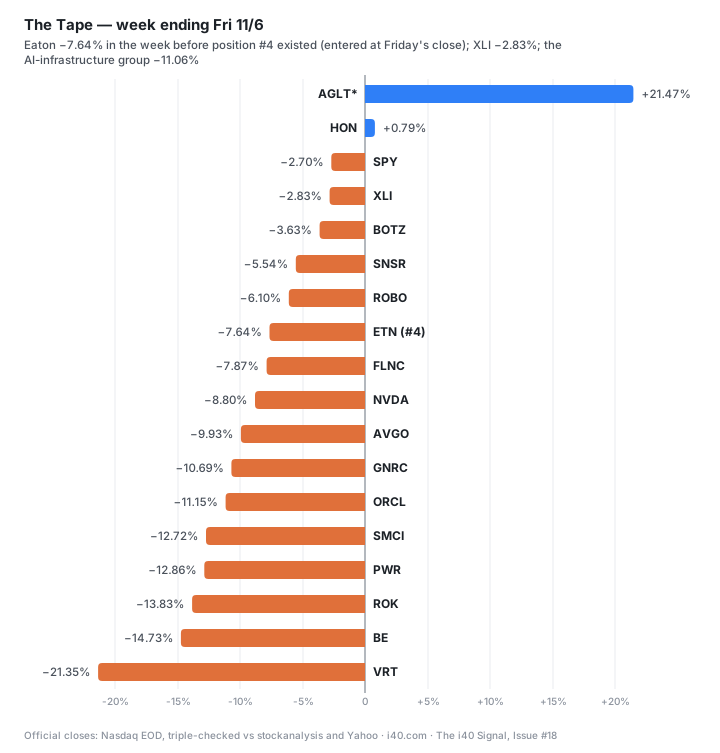
The AI-infrastructure group is equal-weight ETN, PWR, SMCI, NVDA, AVGO, ORCL, GNRC and BE. The standing eight-name AI-infra group continues to print for thematic continuity, though Position #4 is graded strictly against XLI. *AGLT is Agility (CCXI until 11/4); its +21.47% is de-SPAC float mechanics, not a thematic signal. ETN (#4) entered at Friday's close; its week is pre-entry context.
Eaton −7.64% against XLI −2.83%; the group −11.06% and the group ex-Eaton −11.55%, Eaton 3.92 points ahead of it; Vertiv −21.35%. SPY fell 2.70%, its worst Friday-to-Friday week since the week ending 4/4/2025 (computed on Yahoo's weekly closes; 24/7 Wall St agrees), and its −4.41% on Thursday was its worst session since 4/4/2025. Equal weight beat cap weight for a third straight week (RSP − SPY +1.67). The buyers held up while their suppliers fell: AMZN +7.88%, GOOGL +1.77%, MSFT +1.67%, META −0.79% against MOD −25.55%, VRT −21.35%, SEI −18.29%, FIX −17.45%, NVT −15.69%, PWR −12.86%.
Eaton's sessions: Tuesday's print day +7.00%, on our reading a group up-day with an Eaton premium of about two points (the group ex-Eaton rose 4.66%); Wednesday −9.86%; Thursday −7.38%; Friday +4.50%, 4.37 points ahead of XLI into the entry close.
The Record
Missed this week: zero (the running count stays at three): no event that required a same-day session went without one. Pennsylvania's Thursday order did not fire (Tripwires), but it was not detected until the weekend session: the mid-week docket sweep ratified October 2 remains unarmed in our systems, and we sweep these dockets only once per week, during the weekend editorial run. [11/17: The sweep was still unarmed at publication, and the week ending 11/13 was swept on Tuesday 11/17; Issue #19 amends the throttling trigger's action.] Position #4's entry was locked and posted on Sunday 11/8: an entry is neither a falsifier trigger nor a close, its anchor was pre-published on 11/4, and posting it Sunday changed no number, as with #3's Sunday entry in August. Origination: hold, now a filter rather than an empty-book default; the book holds one of a three-to-five target.
Scoreboard (total-return, exit anchors). #1's foregone gain widened 0.56 to +5.19 (BOTZ −3.63% against XLI −2.83%). #2 survival dividend: +1.70. Holding past 8/7 would now have GAINED 4.13 points TR against ROK, inverting our Issue #16 post-mortem. 11/5 and 11/6 are the only sessions since 8/7 on which HON has out-performed ROK since the exit, driven almost entirely by Thursday's session, when ROK fell 14.15% on its FY27-guide day. [11/17: True as of the 11/6 close; the count reached five with 11/9, 11/10 and 11/11, the flip reversed from Thursday 11/12, and the sign flipped back at Monday 11/16's close, after the graded week (see Issue #19's scoreboard).] Issue #16's post-mortem was true when printed: this is an update, not a correction. #3: the cut has avoided 8.38 (VRT −11.41% against XLI −3.03% since the 10/16 exit), from a cost of 12.85 at 10/30, a swing of −21.23; the sign flipped on Wednesday 11/4. [11/17: A figure as of the 11/6 close; see Issue #19's scoreboard.] Avoided 8.38 does not vindicate the limit's depth, exactly as cost 12.85 did not condemn it. The realized record is unchanged: −8.19 across three closes.
Rockwell's Thursday. #2's short leg opened 9.22% lower after its pre-open release and closed down 14.15% (443.88 → 381.05). Dated secondaries tied the fall to the Q4 revenue miss ($2.33B vs $2.41B consensus). Rockwell attributed ~4 points of the Q4 growth drag to a customer tariff-refund accrual. Consensus: Investing.com. Secondaries: TIKR, Benzinga, Rallies.ai and a Chartmill headline, all 11/5.
Forward flags. Honeywell goes ex $0.70 on Friday 11/13 (−0.28 on #2 from the grade of the week ending 11/13); Rockwell goes ex $1.45 on Monday 11/16, declared 10/30 after W45's close (+0.33 from the week ending 11/20); net +0.04.