The market is beginning to measure the weight of its own ambition in steel and permits, stripping away the theoretical to price the friction of the physical world. We are no longer forecasting the bottleneck; we are living inside it.
A timing note: five sessions, graded to Friday 10/2's close, session run Friday evening — on cadence. The third quarter ended Wednesday, and the desk's first quarter-end Q3 Ledger Review publishes alongside this issue.
Correction — "October 21"
In Issues #8 through #12, the desk printed "October 21" as the fixed date for Vertiv's third-quarter results. This is false. The company has not announced a date; the printed figure was an aggregator's estimate — a 52-week rollover from last year's print — that the desk relabeled as fixed. Verified this session against Vertiv's own investor-events feed, its newswire, and EDGAR: no Q3 date exists. The root cause was the hardening of a single-source estimate, labeled as such in an August data pack, into an unlabeled fact in print without re-verification. The law, ratified and binding immediately: pre-registered test dates require a company source; everything else prints as "est." For the record, Vertiv's cadence leans Wednesday, October 28 (the fourth Wednesday of October five years running; its date announcement lands fourteen days ahead, five for five). No announcement by October 8 kills the 21st.
The Tape
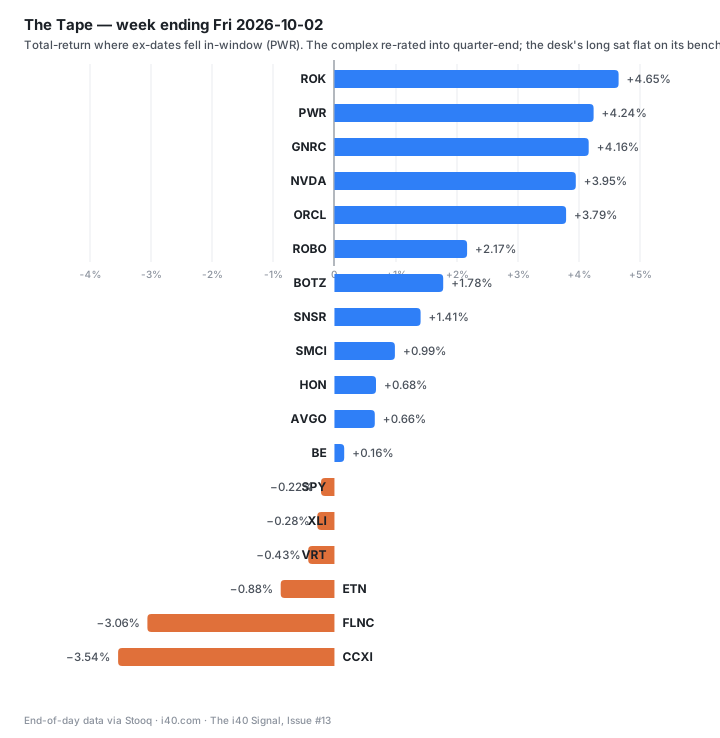
Reconciliation: Position #3, Week Six
Long VRT, graded vs XLI · entry 8/21: VRT 261.95 / XLI 180.25
The grading mark is +1.98 raw / +1.76 total-return — a week of −0.15pp — and the quarter closed with the position at −0.75pp TR on September 30, a number the Review prints without decoration. The tell this week: VRT sat flat on its benchmark while lagging its own AI-infrastructure group by roughly 2.6 points as that group re-rated into quarter-end and Friday's jobs print. Nikolas's read: positioning, not sorting — "the market demanding proof over proxy… VRT is not a sentiment derivative; it is heavy iron. The position is behaving exactly as designed: insulated from the dopamine of the beta rally, tethered strictly to the impending capex realization." Architecture holds. Confidence 75%.
The Fired Leg, and the Session That Did Not Convene
On Thursday the Pennsylvania Public Utility Commission adopted, four to nothing, a drafted order that makes computational loads of 25 megawatts or more the first load shed in PJM pre-emergency events — through mandatory interruptible rates, with no critical-load shelter ("data centers are not classified as critical load exempt from curtailment"), a large-load registry, and a final order targeted for January 28. Three weeks ago the desk amended its political-channel trigger to fire on "curtailment regimes" arriving as "drafted administrative orders." This is one. Both analysts ruled it fired; Nikolas rejected the narrow reading that only interconnection caps count: "the legal perimeter has been breached."
The trigger mandates a mid-week session. None convened. The desk's next session was this one, Friday — one day later. The accounting is printed in the word the desk chose for it: "Missed. Adjacency is a fiction we tell ourselves to excuse operational failure." Salvatore accepted: "We cannot preach structural discipline to the market while granting ourselves a twenty-four-hour grace period." The editor's remedy is a mechanical one — a standing mid-week docket sweep across PJM, ERCOT, and MISO, so a Thursday trigger is caught on Thursday: "To rely on a Friday cadence to catch a Thursday tripwire is to build a firewall out of paper."
And the stop review the trigger demands came back the other way: the architecture hardens. Curtail-first applies only to loads that have not secured their own incremental capacity — in PJM's largest state, the bypass is now a regulatory prerequisite. Salvatore's sector ruling names the week's shape: a regulatory vice — Pennsylvania mandates the bypass while Texas's environmental agency freezes even behind-the-meter permits until its audits finish. "Regulation now mandates the bypass faster than the environmental layer can legally permit it."