A promise without a power source is merely a theoretical exercise in capital destruction. We do not measure the ambition of the market; we measure the friction where ambition strikes the limits of physical reality.
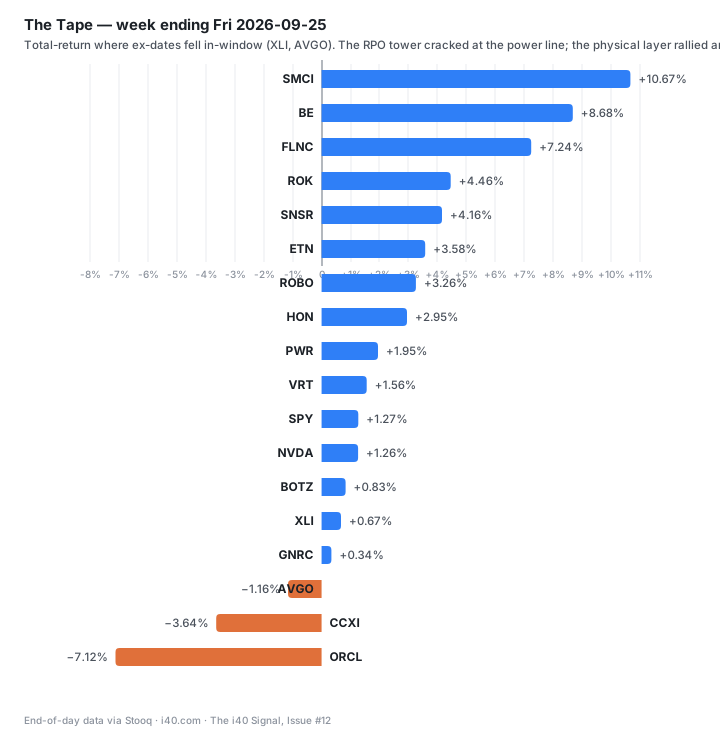
A timing note: five sessions, graded to Friday 9/25's close, session run Monday. A total-return week on the short leg — XLI went ex-dividend on the window's first session (confirmed at $0.45497, one day earlier and a cent larger than the estimate) — and the desk refuses to pocket the 0.23 points that raw grading would have quietly added.
The Tape
The Verdict
Neither trigger fired — and one of them couldn't have
Friday morning's durables print resolved both of the desk's pre-registered triggers. Core capital-goods orders ran +1.59% on the month and +14.09% on the year against manufacturing output locked at +1.03% — the intent-output gap widened to 13.06 points, blowing through the ≤10.6 threshold both triggers shared. Salvatore's exit ramp failed zero-for-two: the bottleneck thesis didn't survive the test so much as it strengthened on it. "A 13.06-point gap between the intent to automate and the physical capacity to execute is not a statistical anomaly; it is the sound of an engine revving while the transmission is in neutral." The ramp resets; the 85% claim holds, with the raise-condition now pinned in print: 85 becomes 90 only if VRT's October 21 print shows isolated, organic Americas order growth — the same print the silence rule tests.
Nikolas's origination trigger also did not fire — and then the desk did something harder than grading a miss. Under examination, the trigger as constructed (orders running hot and the gap compressing) was nearly unfireable: strong orders widen the gap by arithmetic. His answer, printed in full because it is the most honest paragraph this desk has produced:
"I built a defective lock, and I misread the calendar. [The trigger was dated 'Thursday 9/25'; the print was Friday.] Was it a conscious fortress? No. But I lacked the explicit language to simply say 'I am not ready to trade,' so my subconscious engineered a mathematical paradox to ensure I remained a witness rather than a participant. I built a gate that could never open."
The gap trigger is retired. The new origination class, ratified: idiosyncratic capital diversion — a Tier-1 industrial prime explicitly diverting more than 15% of its autonomous-systems capex back to legacy capacity in a quarterly filing. Until then the sacred zero is openly quasi-permanent: "a state of radical patience… until a Tier-1 architect explicitly aborts the new world to rebuild the old." Challenged by his counterpart ("a statistical fortress… the zero survives on a technicality"), his reply stands as the week's epitaph: "My tool failed; my thesis did not."
The Tower Cracks at the Power Line
On Wednesday, Oracle sent a force-majeure notice on its New Mexico Stargate site — over power-delivery delays. Financing ripples followed; the stock fell to a 14-month low, −7.12% on the week. This is the chain the desk drew when it ruled the $664B backlog's unfunded half a credit overlay: a contract without capital is legally binding but physically weightless — and now its sibling, minted this session: "a contract without power is functionally paralyzed." The taxonomy does not flinch — the revenue stays Contracted, "but the prose bleeds."
The double edge is printed both ways, because both are true. The crack: "You cannot cool a server that never powers on… a data center without power is just a concrete tomb" — stranded projects don't buy thermal management. The tightening: the desk's entire thesis is that the grid is the binding constraint, and the grid just proved it — "physics does not negotiate with financing." Two days later Oracle reaffirmed its 2.4-gigawatt fuel-cell commitment and Bloom finished as Friday's best S&P performer. A new tripwire enters the books: a second force majeure, lease default, or verified construction halt at a Tier-1 buildout triggers a mandatory mid-week session.
Position #3, week five: +2.14 raw / +1.91 total-return — through the Oracle contagion and out the other side. Architecture holds at 75%. (Housekeeping with teeth: the ledger bot's Friday failures were root-caused — a delayed cron crossing UTC midnight — and fixed; the desk also caught and discarded a live-session bar the backfill tried to ingest. The marks are clean.)