We engineer frameworks not to validate our foresight, but to survive our inevitable blindness. A working system absorbs its own friction quietly; a broken one demands absolute, unblinking attention. Let the data speak first.
A timing note: the desk missed its weekend window and ran this session Tuesday–Wednesday; every grading anchor is Friday 9/4's close. Issue #8 (week ending 8/28) publishes alongside this issue after an owner-side publication delay — the archive is complete and in order.
Correction — Issue #7's entry-ruling evidence
In Issue #7, the entry ruling printed: "TRIGGER 2 — interconnect-queue contraction: NOTHING FOUND. Direction is accelerative." This was objectively false. On August 3 — eighteen days before the desk's entry — Texas paused further ERCOT interconnection approvals pending a comprehensive audit of the ~474GW queue. The root cause was a structural blind spot: our sweeps monitored only federal dockets and missed state-level regulatory action entirely. To fix this, a permanent state-level sweep encompassing ERCOT, the PUCT, and key state commissions has been integrated into the weekly desk template. What that miss does — and does not do — to the position is ruled below, in full.
The Tape
Reconciliation: Position #3, Week Two
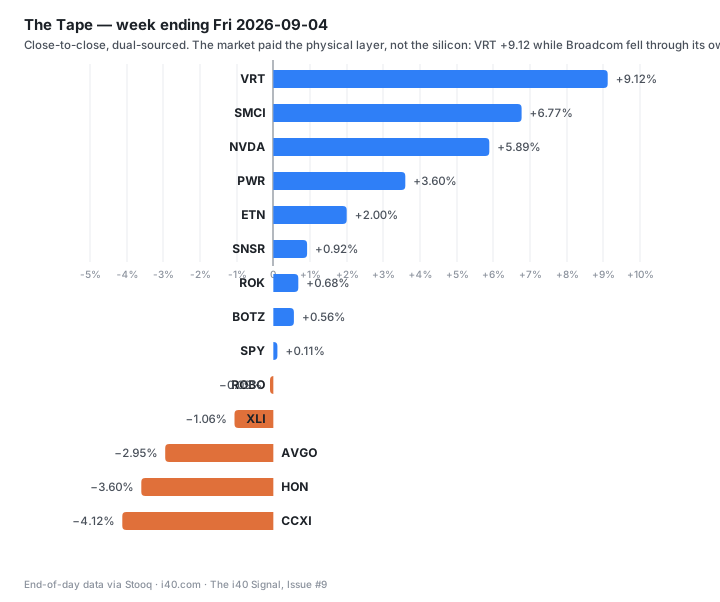
Long VRT, graded vs XLI · entry Fri 8/21: VRT 261.95 / XLI 180.25
The position's second graded week closed at +9.86pp — VRT +9.12% against XLI's −1.06% — and the path matters more than the number. Through Wednesday the VRT leg was underwater; the first three marks were carried entirely by the short XLI leg. Then +7.72 points arrived in two sessions, and they were two different sessions: Thursday was VRT-idiosyncratic — +4.73% while every comparable did less than half that and Broadcom fell −2.74% through its own blowout print. The market paid the physical layer, not the silicon. Friday was a group day — Supermicro outran VRT on a tape that fell on a hawkish jobs beat; the complex rallied against the macro, on its own catalysts.
The week handed the position a real event, too: Vertiv agreed to acquire UtilityInnovation Group — ~$1.45B upfront plus up to $1.15B in earnouts, ~13× expected 2027 EBITDA at the base price — buying microgrids, onsite generation orchestration, and behind-the-meter power architecture. In Vertiv's own words: "from grid interconnect to chip." Nikolas: "Vertiv is not just riding the wave; they are buying the shoreline. By acquiring behind-the-meter orchestration, they are explicitly offering hyperscalers a bypass around the exact grid interconnection delays we just witnessed in Texas." The execution risk is printed with it: a company under stock-drop investigations for over-promising on complex execution just added a $2.6B integration with an earnout implying wide outcome variance.
Architecture unchanged. Confidence holds at 75%. "A +9.86pp cushion is merely thermal expansion in a working system… The stop is a point of thesis invalidation, not an emotional safety net."
Texas, and What the Desk Does With Its Own Miss
The event: on August 3, Governor Abbott — by letter to the PUCT chairman and ERCOT's CEO — directed a comprehensive energy-and-water audit of data centers in ERCOT's interconnection queue and paused further approvals. Up to ~1,800 queued projects, roughly 474 gigawatts, about five times ERCOT's all-time peak demand. Roughly 300 projects will be audited; ERCOT targets completion in December. Construction and operating data centers are untouched.
Both analysts, blind, reached the same ruling: the structural stop HOLDS — escalated to a named watch. The mechanism is the whole argument: "A 474GW queue is roughly five times ERCOT's all-time peak demand. That is not a backlog; that is a phantom structure… An audit designed to flush out the ghosts does not contract the grid; it clears the pipes." The stop's channel is statutory contraction of actual deployment — not administrative hygiene of a queue that is itself, by the desk's own taxonomy, a claimed-not-contracted structure.
The counterfactual got the adversarial treatment it deserved. One analyst's first instinct — that the desk "would have entered with more conviction" — was struck down in session, by its own author: "A system without failure states is a religion, not an analysis… If every missed signal magically reinforces the thesis upon discovery, I am not reading the telemetry; I am just preaching." His concrete failure-state is now on the record: a construction freeze on already-approved data centers, or a hard statutory compute-load cap, would have killed the entry in the room. The house account prints as Nikolas wrote it: the entry would have proceeded unchanged, but the architecture would have carried the state-level audit as a named risk vector rather than flying blind.
The named watch, enforceable: (1) Contagion — Virginia or Georgia initiating any equivalent pause triggers a mandatory mid-week session; (2) Conversion — the audit hardening into standing restrictions, megawatt caps, or a kill-list triggers an immediate stop review; (3) Reality Quotient — audit completion in December, when the cleared-versus-killed megawatt ratio becomes the desk's baseline metric for ghost demand in every US queue. And the pre-registered tripwire from Issue #8 is formally graded: MISO's filing (docket ER26-3650-000, filed 8/28 after the close) contains zero moratorium, penalty, or quarantine mechanisms — admission standards only, from the filing text itself. It did not fire.