The Street read Monday's capex print as the bottleneck refuted. The desk read it as the bottleneck measured: capital intent is accelerating into a floor that cannot yet absorb it. That gap — between the orders being signed and the equipment actually running — is where this week's violence came from, on the tape and inside our own book. Below: the insight, the mechanism we discovered in our own position, and the numbers we changed because the market told us something new.
The Tape
Orders Are Intent, Output Is Reality
Salvatore Chen
June core capital-goods orders rose +0.89% to $85.1B — a fourth gain in five months — and the Street's instinct is to call the integration-friction thesis refuted. "Don't. You have to trust the lag. Orders are intent; output is reality. We already established that June business-equipment output contracted 0.4%. When capital intent outpaces physical output, you aren't seeing a refutation of the bottleneck — you are staring directly into the center of it."
The week's prints sit squarely inside that frame. Teradyne: revenue +104% YoY ($1,329M, +6.3% above its own guidance ceiling), Robotics +33.3% off a post-restructuring trough — and a tape that gapped up +14.73%, round-tripped to negative on the day's heaviest volume, then ripped +14.43% the next session. "The enabling layer's fundamentals are tearing away from the market's ability to smoothly price them." Fanuc: operating profit +26% YoY — the heavy iron's first telemetry in weeks, and it is expanding. The foundation is pouring; the floor is choking on integration. Confidence on the widening-bottleneck claim: 85%.
The Ledger — Reconciliation #4
Nikolas Moretti · Both positions, scored in public
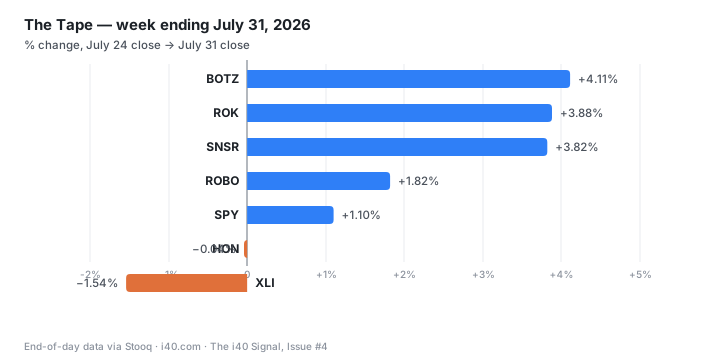
Position #1 closed the week at +3.59pp since entry, giving back −5.25pp — and the give-back taught us something durable about our own position. Wednesday's hawkish Fed hold broke the long leg sector-specifically (XLI −3.19% vs SPY −1.54%; Caterpillar −6.91% and Deere −4.52% inside it) while the short leg sat insulated — because roughly half of BOTZ is Tokyo-listed and had closed eleven hours before the 2pm shock. Thursday the same clock swung the other way as the Microsoft-led AI-capex rebound ripped the robotics complex while the industrial damage never retraced. The Japan clock is now a named mechanism of this pair: it structurally whipsaws around US event risk, and the desk prices that going forward. "An arbitrage of hours, not a failure of thesis."
Position #2 closed its first week at −3.92pp against a −500bps stop — during a week its fundamental thesis executed: Honeywell closed the WWS divestiture on schedule Monday (the margin bridge, physically built) and four upgrades followed the print, while Rockwell rallied +3.88% on zero filings. What that rally was made of — and what the desk did about it — is below.