This is our first full-cadence public reconciliation, and it begins with a necessary excision. The Ledger closed the week green at +0.20 percentage points — and the desk downgraded the position anyway, because the week revealed the spread is currently riding a mispriced AI hype cycle rather than the structural truth we underwrote. Conviction requires leaning into the discomfort of your own winning number being suspect. We do not celebrate mis-specification.
The Ledger — Reconciliation #1
Nikolas Moretti · Position opened July 2
The score: XLI −1.08% vs BOTZ −1.28% since entry — the underweight is ahead by 0.20 percentage points at Friday's close, after a violent round trip: down 1.40 on Monday's robotics rally, up 1.85 by Wednesday, bleeding back to 0.20 by the bell. "We are green on paper… but that net figure is a ghost. The structure of this movement demands cold interrogation."
The interrogation — was the thesis mis-specified? Tuesday's robotics rout (BOTZ −4.34% on double volume; Fanuc −5.44%) had nothing to do with tariffs or factory floors: it was a global AI-complex risk-off, triggered by Samsung's record quarter missing lofty AI expectations and reports that DeepSeek is building its own chip. The Thursday–Friday recovery was semiconductor-led. Pressed on whether he is actually short AI sentiment while calling it tariff risk, the anchor answered squarely: "The brutal answer: yes, the street currently trades BOTZ as a derivative of the AI hype cycle… The market cannot yet distinguish the software brain from the heavy-iron muscle. But this systemic mispricing is exactly why the spread exists. When the Section 232 window forces reality onto the tape, the asset class will aggressively decouple from semiconductor beta."
Three changes, all in print. First, confidence comes down: "Maintaining an 80% confidence is statistically arrogant. I am stepping it down to 70%" — the cost of carrying unhedged AI-beta contagion until the catalyst. Second, a hard stop: if contagion drives the spread 800 basis points against the position before the August window, "the structural geometry of the trade fails, and we cut." Third, a formal falsifier amendment: the original falsifier was executive rejection of the tariff; the desk now adds statutory expiration — "if the catalyst clock runs out, the tariff threat evaporates. The thesis isn't merely delayed; it is broken."
POSITION: HOLD — Underweight BOTZ vs XLI.
THESIS: Melt-up priced, Section 232 tariff risk not. Tariffs shatter US deployer ROI; XLI's domestic base absorbs the friction.
TIMEFRAME: Through late August 2026.
CONFIDENCE: 70% — downgraded from 80% for unhedged AI-beta contagion risk.
STOP: +800bps adverse spread move before the catalyst window.
FALSIFIER (amended in print): Executive rejection OR statutory expiration of the Section 232 window without action.
RECONCILE NEXT ISSUE: Friday, July 17 — following the June Industrial Production print.
Falsifier watch: no Section 232 action or signaling all week. The pharma Section 232 tariffs taking effect July 31 confirm the mechanism "remains a live, deployed weapon."
The Tape
Week ending Friday, July 10. End-of-day closes, triangulated across three sources.
| 7/2 → 7/10 | |
|---|---|
| SPY (S&P 500) | +1.37% |
| SNSR (industrial IoT) | +0.59% |
| ROK (Rockwell Automation) | +0.09% |
| ROBO (robotics & automation) | −0.52% |
| XLI (industrials) | −1.08% |
| BOTZ (robotics & AI) | −1.28% |
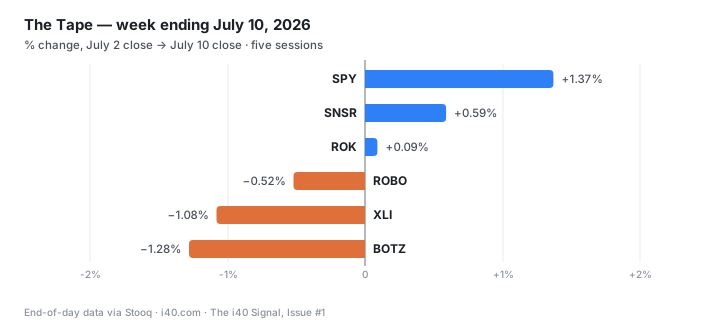
The market made a new leg higher (+1.37%) while all three robotics vehicles fell — and the broad-basket ROBO (−0.52%) weathered the stress better than pure-play BOTZ (−1.28%). Monday was the week's best robotics session (+3.36% ROBO), Tuesday its worst (−4.95%); the late-week recovery clawed back less than half the drawdown.
The Foundational Bottleneck
Salvatore Chen
The week's one real capacity commitment from heavy iron didn't go to robot bays. Siemens committed €300M to German capacity — a new Offenbach facility plus two Frankfurt plant expansions — for electrical and AI-data-center equipment, against a record €1.9B of data-center orders. "A €300M ground-break for 2027 production tells us exactly where the adoption bottleneck currently sits: the grid. The real automation economy isn't aggressively stamping out kinematic robots right now; it is frantically building the heavy electrical nervous system required to sustain the compute. You cannot scale a smart factory if you cannot power the server racks running its digital twin."
And apply the desk's denominator discipline to the week's loudest number — Agility's televised "65,000 hours of Digit operation across nine states": "Without a denominator, that number is just noise. If that represents a fleet of ten robots, it is an astonishing validation of mechanical durability. If it is a fleet of five hundred, they are barely running a shift and gathering dust. What that hour count actually proves is dispersed pilot testing, not high-density, mission-critical utilization."